Practical guide
Planning a Group Walk for Different Walking Paces
Choose a comfortable shared first circuit, return to a known point, then decide who wants to finish or continue. Keep pace, pauses, contact and departure arrangements explicit. The original circuit diagram and planning record are concepts; verify the actual route and access features before inviting people.
Agree the purpose before trying to average everyone’s speed
A mixed-pace walk works better when the group chooses what the outing is for. If the aim is spending time together, agree a pace that the people taking part can comfortably manage. If someone wants a separate brisk workout, name that different goal before setting off rather than letting the fastest walker turn the social outing into a catch-up exercise.
Do not calculate an average of everyone’s usual speed and assume it suits the group. Terrain, pauses, mobility needs and how someone feels that day can change the workable pace. Ask a practical question: “What pace and route would make this enjoyable for you today?” People can describe useful features without providing a diagnosis.
Ramblers’ guidance distinguishes shorter and longer walks and slower and faster paces, recommends checking the walk description, and suggests contacting the walk leader when suitability is unclear. [1] Those are useful habits for choosing an organised walk. For an informal walk with friends, make the equivalent information explicit in your own invitation.
Use a shared first circuit, then decide about an optional extra
The diagram shows a planning idea: one shared circuit returns to a known point, where everyone checks in. Only then decide whether to finish or take an additional circuit. It offers a natural ending for someone who wants a shorter outing without making them the reason the others “failed” to complete a longer route.
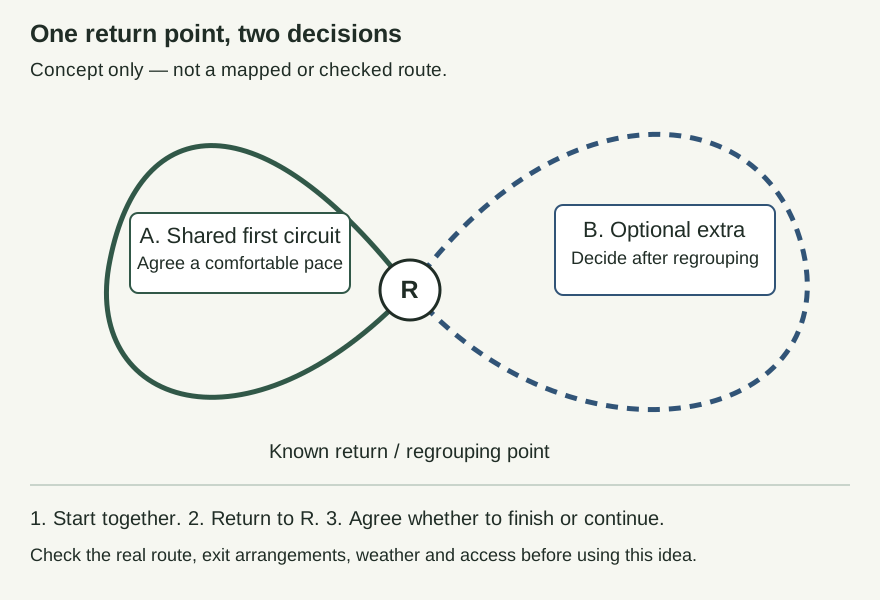
Download the original two-circuit planning diagram (SVG). It is not a map to navigate by. A real place must have a suitable return point and routes you have checked before this arrangement is useful.
The extra circuit does not mean faster walkers leave without notice while others wait indefinitely. At the return point, confirm who wants to finish, how they will leave, and who wants to continue. Someone who has finished can use their agreed departure arrangement; staying to wait for another lap should be a choice.
Choose the route pattern that fits this group
| Pattern | When it may help | What must be agreed |
|---|---|---|
| One circuit at a shared pace | Everyone wants the same social outing and manageable duration. | Current pace, pauses, return point and finishing arrangement. |
| Shared circuit, then optional extra | Some people want a shorter outing; others may want more afterward. | Regroup before splitting; confirm each person’s finish or continuation plan. |
| Short out-and-back together | A suitable loop is unavailable and the group wants a clear turn-back decision. | Actual route, turning point, return time and any crossings; do not assume the return is effortless. |
| Separately planned pace groups | The goals or workable paces differ too much for one shared outing. | Each group needs its own route, people responsible for it and return/contact arrangements. |
Changing the route can be more useful than repeatedly telling a participant to hurry. A shorter common outing followed by a separately agreed extra may meet two preferences. If the place or group arrangement cannot support that, choose a simpler shared plan or organise a different walk.
A loop is not automatically easy to leave. A path can return to its start while still having no practical early exit. Check the actual route and where a person could stop or return with appropriate company if wanted and needed.
Check the real route and the regrouping point
Choose a precise landmark for the start and return point, not only “the park” or “near the station.” Check whether people can reach it, recognise it and leave from it. A café or bench is a usable feature only if it actually exists, is available at the relevant time and suits the people taking part.
| Feature | Question to check |
|---|---|
| Surface and gradients | What is the actual surface, and where are the steeper sections? |
| Steps, gates and width | Are there steps, narrow gates or other obstacles relevant to participants? |
| Crossings and route changes | Where should the group regroup before continuing? |
| Rest places and toilets | Which are confirmed, open and reachable on this route? |
| Early finish and transport | What is the real return or departure arrangement? |
| Current conditions | Are there closures, access restrictions, warnings or weather concerns? |
A flat line on a map does not prove step-free access, a firm surface or suitability for a mobility aid. Describe what you have confirmed and what remains unknown, then let participants assess whether those features meet their needs. Do not copy an organisation’s broad accessibility description onto your own unverified route.
Ramblers’ walk-leadership page provides resources on checking a route beforehand, giving a walk briefing, managing group size and first aid. [2] The diagram here is our own small-group concept, not a Ramblers-approved route or a substitute for that preparation. Check the current forecast and local route information before using it; shorten, change or cancel when the conditions do not suit.
Make five agreements before setting off
- Shared pace. Agree a pace people can manage now, and a simple phrase such as “Could we ease the pace?” No explanation of a private health condition is required to ask.
- Pauses and changes. Check that everyone is accounted for at crossings, junctions and changes of route. A pause should not end just as the last person arrives, denying them a rest.
- Return point. Identify the actual shared return point and what happens there. Do not rely on everyone interpreting “another lap” the same way.
- Finishing choice. Agree how someone can finish or return, with company where wanted and appropriate. Do not replace the plan with “you can find your own way back” after setting off.
- Contact and separation. Choose a known check-in point and contact method suitable for the place, while considering battery and coverage limits. Follow appropriate local help or emergency procedures if there is a safety concern.
If someone wants to slow or stop, respond to the actual request. A useful reply is “Let’s pause here and check the return plan,” rather than “We’re nearly done” when you have not checked that claim. Avoid treating a person’s pace as a character flaw.
For an organised group walk, follow its actual leader’s briefing and arrangements instead of independently applying this informal template. A group’s own rules, route and conditions matter.
An invitation and a regrouping script you can adapt
An original invitation template is: “Would you like to walk together at [time], meeting at [precise landmark]? We’ll do [checked shared route] at a pace we can comfortably manage, then return to [point]. We can finish there or decide together about [checked optional route]. Here are the surface, steps and return arrangements I have confirmed: [facts]. These features are still unverified: [unknowns].”
Add the actual expected duration and finishing limit only after considering the route and the group. A usual solo lap time is not a guarantee for a group walk with pauses. Keep any participant contact details and individual needs out of a public invitation.
At the regrouping point, try: “We’re back at the agreed point. Who would like to finish, and who would like another circuit? Let’s confirm departure arrangements and the time and weather before anyone continues.” Ending after the shared circuit is a completed outing, not an incomplete performance.
Four cases: which agreement is missing?
These original fictional cases test the plan, not a participant’s fitness.
Case 1
The group pauses at a junction. As the last walker arrives, the others immediately move on. Did everyone receive the same rest opportunity?
Show answer and explanation for case 1
No. Check the pause with the arriving person before continuing.
Regrouping and resting are related but different. Being present at the junction does not mean someone has had time to rest; agree how the pause will work.
Case 2
After the shared circuit, two people want another lap. They tell a friend to wait at the meeting point until they return. Was that automatically part of the optional-extra plan?
Show answer and explanation for case 2
No. Waiting must be a choice, and finishing or departure arrangements need agreement.
The extra begins only after regrouping and a fresh decision. The friend may choose to finish using an agreed departure plan; they are not obliged to wait for another circuit.
Case 3
A route looks flat on a map. Can the invitation promise wheelchair-suitable access, open toilets and benches?
Show answer and explanation for case 3
No. Check and describe the actual features; mark unknowns.
A map’s appearance does not establish surface, gates, steps, facilities or current conditions. The conceptual circuit diagram verifies none of them.
Case 4
One walker wants a brisk fitness session and another wants a gentle conversation. Should you choose their average usual speed and call it a shared agreement?
Show answer and explanation for case 4
No. Clarify the goal and find a pace and route that this group accepts.
An average speed does not resolve different purposes or current needs. A shared shorter outing, an agreed optional extra or separately organised pace groups may fit better.
Save the plan and review whether people felt comfortable
Download the different-pace group walk plan (TXT). It includes the real route checks, shared and optional circuits, pace phrases, regrouping and finishing arrangements, unknown features and a brief review.
Afterward, ask whether the common pace worked, whether anyone felt rushed or obliged to wait, and whether return arrangements were clear. Keep one feature people liked and change a specific problem for next time. The useful result is an outing that the participants want to repeat, not identical step counts or a fastest-lap ranking.
Sources and further reading
- Ramblers: What to expect when you join a group walkOrganised walks differ in length and pace; check descriptions, ask the leader about suitability, check weather and follow the group’s actual arrangements. This does not verify our fictional circuit or an informal group’s access.
- Ramblers: Walk LeadershipPublic resource hub lists route reconnaissance, walk briefing, group-size and first-aid guidance. Hub text read; linked videos and training modules not claimed as watched or completed. Our diagram is independent and not organisation-approved.