Practical guide
Hosting a Beginner Walking Meetup: A Practical Checklist
Prepare the first event from invitation to an accounted-for finish. Separate interest, confirmed places and arrivals; explain meeting, missed-start and departure arrangements. Includes three tables, four fictional examples and two editable records.
Define the event you can actually host
To host a beginner walking meetup, prepare the people arrangements as well as the route. Make joining understandable, identify the host at an exact meeting point, confirm who has arrived, give a short briefing and know how departures or lost contact will be handled.
This guide addresses the organiser's first-event workflow. The separate guides below cover different walking paces, detailed route-feature checks and weather changes. Use those where needed; this checklist does not replace them or turn a route into a verified accessible outing.
Start with a small, simple event that the actual hosts can manage. Choose its purpose, route, expected duration range and finish, then consider the people, responsibilities and local requirements. A public invitation can attract a very different number of participants from a walk with a few known friends. There is no universal group size that this page can certify as manageable.
The Ramblers walk-leadership hub identifies preparation, briefing, group-size and first-aid resources. Its hub text has been read; linked videos or training have not been completed here. This original checklist gives practical questions, not leader certification, insurance, permission or an organisation-approved event.
If the outing involves an organisation, children, vulnerable participants, remote terrain or arrangements beyond your experience, use the relevant organisation's actual procedures and appropriate experienced support. Do not assume an ordinary informal-walk template supplies safeguarding, supervision or rescue arrangements.
Make the invitation answer the joining questions
A useful listing lets someone decide whether to join and how to arrive. Replace broad claims such as “easy walk, everyone welcome, meet at the park” with checked facts and an exact event. Put unresolved details beside the affected feature rather than hiding them at the bottom.
| Field | What to state | What to verify | Common gap |
|---|---|---|---|
| Date and timing | Event date, local time/zone, arrival and departure arrangement. | Actual duration range, finish and relevant transport. | Forwarded “tomorrow” message loses its date. |
| Meeting place | Exact entrance, named landmark and host identification. | The place is reachable and available at the event time. | A park name covers several entrances. |
| Walk description | Checked route, purpose, likely surface and relevant limits. | Current route information and essential participant requirements. | “Beginner-friendly” replaces facts. |
| Participation | Who can join, actual booking process, cost and conditions. | Host capacity, permissions and applicable group rules. | Public sharing is treated as unlimited capacity. |
| Reply and confirmation | Where/how to reply and how a place is confirmed. | A contact method the host will actually monitor. | An emoji response is counted as attendance. |
| Late or missed start | What to do if the group has already left. | A workable contact or non-participation arrangement. | Late walkers are told to chase the route. |
| Changes and contact | Decision owner, current-plan channel and useful notice time. | Backup for a missed message or changed meeting point. | Posting proves everyone received the change. |
Ramblers' participant guidance recommends checking the walk description, contacting the leader when suitability is unclear, and booking when the walk requires it. Its organised-walk arrangements are context, not facts about your event. State your own process accurately.
For access questions, the U.S. National Park Service advises contacting the particular park ahead of time. Use the actual operator for your chosen place and describe confirmed features, relevant unknowns and limits. Do not borrow a whole park's accessibility label for an unverified entrance or route.
Keep replies, confirmed places and arrivals separate
Choose how a participant requests a place and how you confirm it. A public page view, a “sounds nice” reply and an accepted booking are different things. Record the current state so the hosts know what they are preparing for. If friends bring additional people, ask for confirmation through the same process.
| Status | What it establishes | Next organiser action |
|---|---|---|
| Interested or invited | Someone has seen or responded to an idea. | Ask whether a place is requested; do not count an arrival. |
| Place requested | A person has asked to join this event. | Confirm whether the actual arrangement and capacity allow it. |
| Confirmed place | The host and participant have the specified joining arrangement. | Provide the current meeting and contact details. |
| Arrived | The person is physically present and accounted for. | Include them in the departure count and briefing. |
| Cancelled or missed start | A cancellation or missed-start outcome is actually known. | Update the record and use the agreed next step. |
| Left by agreement / whereabouts unknown | An agreed departure is different from unaccounted-for absence. | Record the confirmed departure or use the contact/help arrangement. |
Reassess the event if numbers grow. Can the hosts welcome people, explain the plan, maintain the agreed group arrangement and respond to a problem without abandoning the rest of the group? Change capacity, provide appropriate support or organise a different event when the arrangement cannot cope. This is a practical review, not a numerical risk score.
Agree who knows the route, who accounts for people and who coordinates questions or changes. A second person is useful only if they have agreed the role and can actually perform it. Naming a volunteer does not create their availability, first-aid qualification or authority.
Keep contact details and individual needs in the appropriate private arrangement, with participants' knowledge. A public invitation can describe a step-free requirement without identifying whose health or mobility needs prompted it. This page is not collecting registrations, sending messages or storing anyone's personal information.
Welcome people, account for arrivals and give the briefing
Make the host recognisable in a way that works at the actual place. An exact entrance and visible landmark are more useful than “near the big tree.” A photograph can help only when it really shows the current meeting point; do not use an unrelated stock image as wayfinding evidence.
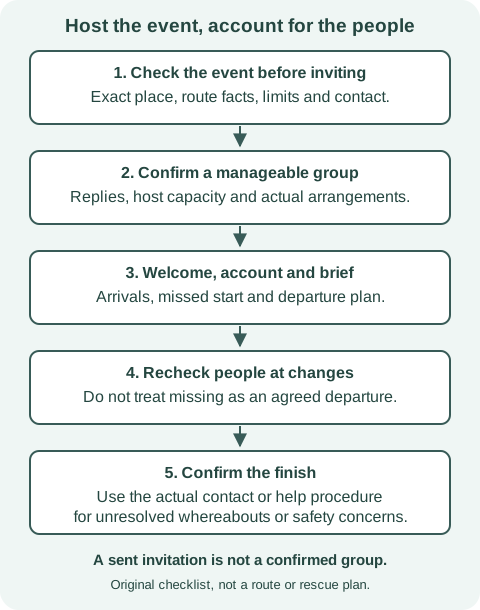
Before departure, distinguish confirmed places from people who have actually arrived. Check cancellations and the agreed missed-start arrangement. An absent person may never have travelled; do not label them lost without evidence. Equally, do not assume someone who was present has gone home when their whereabouts later become unknown.
Give a short briefing that people can hear or otherwise use. State the selected route and finish, the agreed pace/pauses, the next regroup points, how to ask to stop and what to do before leaving. Include the actual contact method and its limits. Invite practical questions without asking everyone to publicly explain a medical condition.
An original briefing draft is: “We are [accounted-for group] leaving from [exact point]. The current plan is [route/finish]. Please tell [named host] before leaving the group. At [designated changes] we will pause and account for people. If separated, use [agreed arrangement]; do not rush after the group or take an unverified shortcut. For an immediate safety concern, use the local help procedure.”
Replace brackets with an arrangement the hosts can carry out. A familiar route does not make mobile coverage reliable. Discuss battery, signal and any other communication limits before relying on the contact method. A paper note may make an agreed point easier to remember, but it does not supply a missing return or help plan.
Organised groups should use their actual leader's briefing and procedures. This suggested wording does not override them. People with individual health or exercise questions should use appropriate qualified advice; a host's attendance check is not medical clearance.
Separate a missed start, an agreed departure and lost contact
Write the ordinary missed-start arrangement before the event. It might say to contact the host before attempting to join, or that someone who misses departure should not try to catch the group. Choose a workable arrangement for the real route and group; do not promise that the host will monitor a phone while also handling every other task.
| Situation | What to establish | Arrangement to use |
|---|---|---|
| Confirmed participant never arrives | Whether they cancelled, missed the start or need contact. | The agreed pre-departure/missed-start process; do not invent a location. |
| Late participant requests to catch up | Actual group location and whether joining can be arranged. | Host confirmation, or do not join; no rushing or guessed shortcut. |
| Participant wants to finish early | Their intended departure and the workable return/support arrangement. | Confirm with the relevant host before separating and update accounting. |
| Someone present is now unaccounted for | Last confirmed place/time, immediate concerns and group location. | Keep the group accounted for and use the actual contact/help procedure. |
| Phone contact fails | Failure of this contact attempt, not proof of injury or departure. | Record the outcome and follow the agreed local next step. |
If someone is unaccounted for, pause the plan where it is appropriate and safe, establish the last confirmed information, and keep the remaining group together through the actual arrangements. Identify who coordinates contact and who stays responsible for the group. Do not send inexperienced people into unknown terrain, split into an improvised search or treat an unanswered call as proof that someone is safely home.
Use the relevant land-manager, organisation or local emergency procedure for the situation. An immediate danger or serious health concern needs appropriate urgent help; do not wait to finish this checklist or observe an invented “missing for 30 minutes” rule. Provide the actual location, last confirmed information and observed concern when seeking help. This page supplies no rescue protocol or universal waiting period.
Weather can also change the immediate action. NWS lightning guidance says no place outside is safe when thunderstorms are in the area and advises immediately moving to appropriate safe shelter when thunder is heard. Do not delay that action to finish a count, complete the loop or wait under an isolated tree. Use the separate rain-plan guide for the fuller weather decision; local conditions and emergency arrangements govern the actual outing.
Four fictional first-event problems and clearer arrangements
These invented examples show organiser decisions, not completed events or tested routes.
1. A public post attracts more people than the host expected
Jo expected a few friends, but a forwarded invitation generates many requests. The draft still says “just turn up.”
Clearer arrangement: Confirm the event's actual capacity and joining process before accepting additional places. Reassess hosts and responsibilities; change the event if the current arrangement cannot handle the group.
Interest is useful, but it is not automatically a manageable confirmed group.
2. Two entrances use the same park name
Amir is at the west gate while the host is at a different entrance. Both think “park entrance” was precise.
Clearer arrangement: State the exact entrance and recognisable host before travel. Use the agreed contact method to resolve the actual location; do not send someone through an unchecked shortcut to recover the schedule.
Correct the invitation for the next event rather than blaming the newcomer for an ambiguous description.
3. A late arrival wants to run after the group
Elena arrives after departure and asks a chat participant which path looks quickest. The host has not confirmed a joining point.
Clearer arrangement: Use the actual missed-start process and ask the host. Without a confirmed workable arrangement, do not attempt to catch up or guess a route.
A desire to join does not verify the group's location or a safe shortcut.
4. The count changes after a junction
Chris was present at the previous stop but is no longer accounted for. Another walker says “probably went home,” without knowing.
Clearer arrangement: Record the last confirmed place and time, account for the remaining group and use the actual contact or help procedure. Only mark an agreed departure when it is confirmed.
Do not turn uncertainty into a reassuring story or an improvised search plan. Immediate safety concerns need appropriate help directly.
Copy the invitation and group-status records
Use the invitation card for the public event facts, with a suitable private contact route. Use the second record for actual arrivals, confirmed departures and unresolved contact. Neither is a registration platform or an emergency plan.
BEGINNER WALK — INVITATION DRAFT
Event name / date / local time and timezone:
Arrival window / briefing / intended departure:
Exact entrance, landmark and how to recognise host:
Checked route / expected duration range / finish:
Confirmed route features and relevant unknowns:
Who can join / booking, cost and actual capacity:
Reply method / deadline / confirmation status:
Contact route for questions or a missed start:
Late arrival: wait or do not attempt to catch up:
Early departure and group-accounting arrangement:
Weather decision owner / notice time / channel:
This is a draft until the relevant details are checked.
BEGINNER WALK — GROUP STATUS AND CONTACT RECORD
Event / current plan version / people responsible:
Expected / arrived / cancelled / not yet confirmed:
Count at departure and designated regroup points:
Person left by agreement / arrangement / recorded by:
Unaccounted-for person / last confirmed place and time:
Current group location / immediate safety concerns:
Agreed contact attempt / outcome / time:
Who stays with group / who coordinates contact:
Local help or emergency procedure and actual location:
Next action / responsible person / confirmed outcome:
Do not mark unknown whereabouts as an agreed departure.
Keep individual contact and health information private.
Download both editable records, three reference tables and six explained cases. Fill only the useful fields, keep current information identifiable and handle individual details through the appropriate private arrangement.
Case 1
Twelve people respond “interested” to a public invitation. Does that establish twelve confirmed places or twelve arrivals?
Show answer and explanation for case 1
No. Interest, a confirmed place and an actual arrival are different states.
Use the stated request and confirmation process, review host capacity, and separately account for people at the event.
Case 2
The invitation says “meet at the park,” which has several entrances. Can the host assume everyone will choose the same gate?
Show answer and explanation for case 2
No. Specify and verify the exact entrance, landmark and host identification.
The place name is incomplete joining information. Current entrance availability and the actual approach still need checking.
Case 3
A participant arrives late and finds a possible shortcut. Should they rush after the group without the host confirming a joining arrangement?
Show answer and explanation for case 3
No. Follow the actual missed-start contact or non-participation arrangement.
A guessed shortcut does not establish the group location, route conditions or an acceptable way to join.
Case 4
A person present at the last stop is unaccounted for, and someone guesses they went home. Is this an agreed departure?
Show answer and explanation for case 4
No. Keep their whereabouts unresolved and use the actual contact or help procedure.
A departure needs confirmation. Record the last confirmed place and time, keep the rest of the group accounted for, and seek appropriate help for immediate concerns.
Case 5
The group cannot reach someone by phone. Must it wait a fixed interval from this checklist before seeking urgent help?
Show answer and explanation for case 5
No. This checklist supplies no universal waiting period or emergency threshold.
A failed contact attempt is information, not a diagnosis or confirmed departure. Immediate safety concerns require appropriate help through local procedures.
Case 6
All invitation fields are filled in, but a required route feature remains unverified. Does completing the form certify a suitable outing?
Show answer and explanation for case 6
No. Keep the essential uncertainty visible and resolve it or change the plan.
The form organises facts and decisions. It does not inspect a route, certify accessibility, provide medical clearance or authorise the event.
Confirm the finish and improve the next invitation
At the finish, account for the people taking part and confirm any relevant agreed departure or onward arrangement. A final group number cannot resolve an earlier unknown whereabouts by itself. Deal with an unresolved person or safety concern through the actual process rather than closing the record because the advertised duration has elapsed.
Ask one specific joining question afterward: “Was the meeting point and host easy to identify?” Then review the part the hosts found difficult: too many unconfirmed replies, unclear departure timing, a contact method that was not usable or an early departure not recorded.
Change that part of the next event. A clearer entrance description or workable confirmation process can be more useful than a longer route. Do not claim that a successful first meetup proves treatment benefits, future attendance or universal accessibility. People may prefer a quiet walk, a different group or no participation; those choices do not make the event a failure.
Before repeating, check current route and facility information and local warnings again. Retain the working invitation structure while updating its actual facts. If the group or setting changes, review host capacity and responsibilities rather than assuming the first arrangement scales automatically.
Sources and further reading
- Ramblers: What to expect when you join a group walkWalk description, leader questions, booking where required, timely arrival, privacy and photo permission in an organised-group context; no evidence about our fictional events.
- Ramblers: Walk LeadershipPublic hub identifies preparation, briefing, group-size and first-aid resources. Hub fully read; linked training and videos not completed or presented as certification.
- National Park Service: Accessibility — Plan Your VisitContact the particular park ahead of time about disability-related questions or assistance. Does not verify the route, meeting entrance or participant requirements.
- U.S. National Weather Service: Lightning TipsNo safe outdoor place near thunderstorms and immediate appropriate shelter when thunder is heard; no delayed count, isolated-tree shelter or actual forecast claim.
Connect the invitation to the journey
For participants arriving by public transport, calculate the station-to-meeting approach and work backward from the return service. An arrival time does not establish that somebody is ready for the briefing.