Practical guide
Planning an Indoor Walking Route in a Small Space
Plan a clear indoor path with a workable return and stopping place. Two original non-scale diagrams, practical route checks, household examples and a comfort record help you choose or change the setup without lap targets or medical clearance claims.
Choose a route you can start, stop and leave
An indoor walking route needs a clear path, a workable change of direction and a reachable place to finish. In a small room, the difficult part may be a chair corner or a door opening into the path, rather than the distance. Choose the route around the space you actually have today.
This guide is for adults considering ordinary walking at home, not a prescribed exercise session or a balance test. The original diagrams show planning ideas, not measured room layouts. They do not establish clearance for a person, walking aid or wheelchair. If your mobility, balance or professional instructions make the setup uncertain, seek individual advice before using a new route.
Start with three questions: Where would I begin? Where would I change direction? Where could I stop without having to complete another lap? A route that requires stepping over objects, squeezing around furniture or keeping a doorway blocked needs a different arrangement. A room can be unsuitable for walking even when there is enough space to stand.
Check the whole path, including the way out
Look along the proposed path before starting. Include the approach from your seat, the turning area and the return. Check the floor as it is now: a charging lead, recently cleaned patch or bag put down a few minutes ago can change a familiar room.
| Feature | Question to settle | Reason to change the plan |
|---|---|---|
| Floor and transitions | Is the chosen path dry, visible and free of loose items or unstable rugs? | A spill, curling edge, loose wire or uncertain surface remains. |
| Furniture and storage | Can the route avoid corners and objects without squeezing or stepping over them? | Walking requires weaving around a table or moving heavy furniture. |
| Doorways and household access | Who needs this doorway, and which way can its door open? | The door swings into the path or the walk blocks ordinary access. |
| Turning area | Is a change of direction workable for you and your usual aid, if used? | The only option feels cramped, rushed or uncertain. |
| Lighting and attention | Can you see floor changes and people entering throughout the route? | Poor light or an activity/video distracts from the path. |
| Stopping place | Is the place you intend to finish reachable by the actual path? | A seat or exit is separated from you by a barrier. |
| People and pets | Can you pause before another person or animal enters the lane? | Someone needs to pass, or a pet is crossing the route. |
The NHS falls page advises avoiding clutter and trip hazards such as loose wires or rugs, using footwear that fits and grips, and asking for help with tasks that are difficult to lift or reach. [2] Do not drag a heavy sofa or make an improvised electrical change to create a route. Choose another space or obtain suitable help.
Keep a required exit and normal access usable. Do not wedge a fire door open, block an escape route or use a room in a way its actual rules do not allow. The diagram cannot resolve those building questions.
A room circuit needs usable corners, not just a loop on paper
A circuit can return to a familiar point without a turn at the end of every short straight section. It is useful only when the real space supports the whole route. Drawing a line around a coffee table does not show whether you can move around its corners comfortably.
The first diagram separates a possible clear route from the furniture area. It deliberately gives no room dimensions, clearance standard, pace or number of laps. Check the actual path and its changes of direction for your own use. Do not copy the line onto a room that contains different furniture.
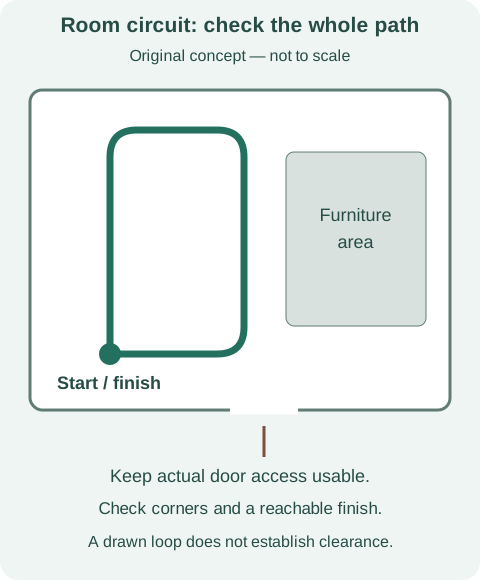
If the circuit makes you weave around furniture, pause the plan and choose a simpler path or a different activity. Do not keep adding smaller turns merely to make the line close. The start and finish should be a place you can reach without an extra obstacle after deciding to stop.
A straight path still needs a real turning and return arrangement
A clear length of corridor can look easier than a room circuit. Its ends matter just as much as its middle. You need a workable way to change direction and return, while keeping doors and household traffic usable.
The second concept shows a path with an end area to check. It does not specify how you should turn, a safe turn radius or suitability for a mobility aid. If turning is difficult or unfamiliar, do not practise an improvised manoeuvre from the arrows; use qualified advice or choose a different arrangement.
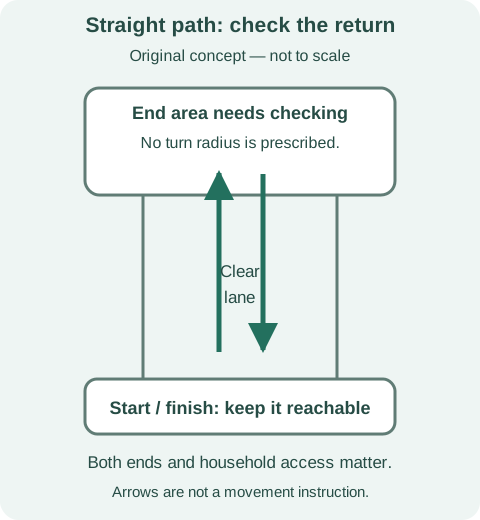
Do not make walking backwards the default return just because the end is narrow. If the route cannot provide a workable change of direction, choose another space or activity. A shorter line does not remove a turning problem.
Check whether the corridor is shared with a bathroom, kitchen or entrance. A route that is available at one moment may become a throughway a few minutes later. Pause when someone needs it rather than asking them to squeeze past a moving walker.
Choose an available household window, not a compulsory timer
Ask when the space is genuinely available. A clear floor is only one part of the arrangement: someone may need the door, a work call may require quiet, or a pet may be using the same room. Agree an easy way to pause and give the space back.
| Situation | Arrangement to discuss | What remains optional |
|---|---|---|
| A shared hallway is busy before departure | Use another checked space or a later available window; keep bathroom and exit access open. | No obligation to finish a walk before the household leaves. |
| A room is quiet during a work call | Agree whether ordinary footfall is acceptable and how to pause if the call changes. | Quiet does not prove that an activity is low effort or suitable. |
| A pet or child may enter the room | Choose a time and supervision arrangement that keeps their needs met; pause if the lane changes. | Do not step around an animal or let a timer outrank an interruption. |
The examples describe household decisions, not tested schedules. You can plan a brief available window without promising continuous walking for its entire length. Setting up, checking the route, pausing or deciding not to walk are legitimate uses of that time.
Keep needed access and responsibilities visible. Do not lock someone out, leave a child without the required supervision or confine an animal unsuitably to preserve a movement slot. If the arrangement cannot support the walk, change the plan.
Keep the first route check free of speed and lap targets
Once the setup is workable and you are considering movement that is appropriate for you, use a comfortable ordinary pace and remain able to stop. Do not add a video instruction to hurry, carry weights or perform rapid direction changes while still learning how the space behaves.
The NHS walking guide discusses gradually increasing distance if you are inactive but able to walk. It also describes brisk walking and general adult activity guidance. [1] Those statements do not prescribe a repeatedly turning room route, or prove that a brief indoor check equals a specified distance or intensity.
There is no lap target, ten-minute minimum or calorie estimate in this plan. A step total does not resolve the setup question. The useful question is whether the chosen path, return and stopping place actually work—not whether an app credits the walk.
If the route or your movement becomes uncertain, stop. Concerning symptoms need appropriate help, not a lower target from this page. If you are worried about balance or mobility, or have had a fall, the NHS recommends speaking to a GP; use the corresponding appropriate service where you live. [2]
Record the setup and comfort without scoring your health
A short note helps separate a room problem from a conclusion about your body. “The door opened into the path” is an observation about the setup. “I am not fit enough” is an interpretation that the door event does not establish.
Record whether you chose not to use the route, changed it or briefly tried it. Leave unknown details unknown. The record is not a test you have to complete, a risk percentage or medical clearance.
INDOOR WALKING ROUTE — SETUP AND COMFORT RECORD
Date / available household window:
Room / selected path / current floor conditions:
Start point / reachable finish:
Door use / required access / people or pets:
Turning area checked / unresolved question:
Usual aid or individual instructions relevant to setup:
Route changed, not used, or briefly tried:
What interrupted the path, if anything:
Was stopping and reaching the finish workable?
Comfort or symptom concern, in your own words:
Observed setup fact / interpretation still uncertain:
Next practical change or qualified question:
No score, pace target, diagnosis or permission to restart.
Keep any private health detail in your own appropriate record. A shared household note can simply say that the route needs clearer access or a different window; it does not need a diagnosis. Download the editable record and six explained cases (TXT).
Choose a different activity when a path does not fit
Some small spaces cannot support a walking path with a workable return. That is useful information. You do not need to turn every available corner into a route, buy equipment or move heavy furniture to make this page applicable.
Walking in place and seated movement are different activities with their own space, support and suitability questions. They are not automatically easier, equivalent to a measured walk or suitable for every person. Use an appropriate activity guide and any individual instructions instead of inventing a replacement programme here.
The home walking alternatives guide helps compare different activity settings. The small-space exercise basics guide addresses activity selection more broadly; small-space movement at home covers household preparation and interruptions. The present record concerns a physical route, not every home exercise option.
Resting or choosing another available day can also be the appropriate decision. Avoid translating “no workable route today” into a missed-step debt that must be repaid later.
Six fictional cases: what should change?
These original cases test the planning decisions, not your balance or fitness. Each answer stays with the actual obstacle, access arrangement or support question.
Case 1: A route is drawn around a coffee table, but two corners require squeezing past it. Is the closed loop enough?
No. The actual corners and stop/exit arrangement matter. Choose a workable path or another activity; a line on a drawing does not establish usable clearance.
Case 2: A corridor is clear in the middle, but its end feels too cramped to change direction. Should walking backwards become the return?
No. A straight middle does not settle the end and return. Choose a different arrangement or appropriate individual advice; do not improvise a return manoeuvre from this diagram.
Case 3: A charging cable crosses the path. Can adding brighter light make the route ready?
No. Visibility does not remove the obstacle. Resolve the actual trip hazard appropriately or choose another path; do not step over it to preserve the plan.
Case 4: The walk window is agreed, but another household member now needs the doorway. Must the timer be finished?
No. Pause and keep required access usable. A time window is an available opportunity, not priority over household passage or permission to squeeze past.
Case 5: An app records few steps during a brief route check. Does that show the setup failed or a longer walk is required?
No. Step credit does not decide whether the path, stopping place and return are workable. There is no required step debt, distance equivalence or intensity target here.
Case 6: Someone feels faint during the walk. Should the record automatically recommend a shorter attempt immediately?
No. Stop and obtain appropriate help for the concern. A room record cannot diagnose the cause or grant permission to restart with a lower target.
Use the sources within their scope and seek help when needed
NHS Walking for Health supplies broad walking advice, comfortable supportive footwear and gradual changes for people able to walk. [1] NHS Falls discusses trip hazards, footwear, support and getting help, with particular relevance to older people and people with mobility problems. [2] Neither source validates our diagrams, room clearances, household windows or comfort record.
If a fall occurs, get help appropriate to the situation. The NHS says urgent emergency help is needed when a person may have injured their head, back, neck or hip, or cannot get up. Its service numbers are UK-specific; use your actual local emergency service. Do not try to lift someone yourself or resume a planned walk to prove recovery. [2]
For ongoing balance, mobility, symptoms or individual exercise questions, seek appropriate qualified advice. A checked floor and a completed record cannot answer those questions. For the broader room setup, use small-space exercise safety.
This page provides original planning tools, not a measured route, a treatment, a falls-prevention guarantee or professional assessment. Keep observations specific, unresolved questions visible and the decision to stop available.
Sources and further reading
- NHS: Walking for healthGeneral walking, footwear and gradual changes for people able to walk; no room-route prescription or distance equivalence.
- NHS: FallsHome trip hazards, footwear and appropriate help; particular relevance to older people and mobility problems. UK services are not generalised worldwide.