Walking for Older Adults: Routes, Support and Confidence
Revised · General activity information
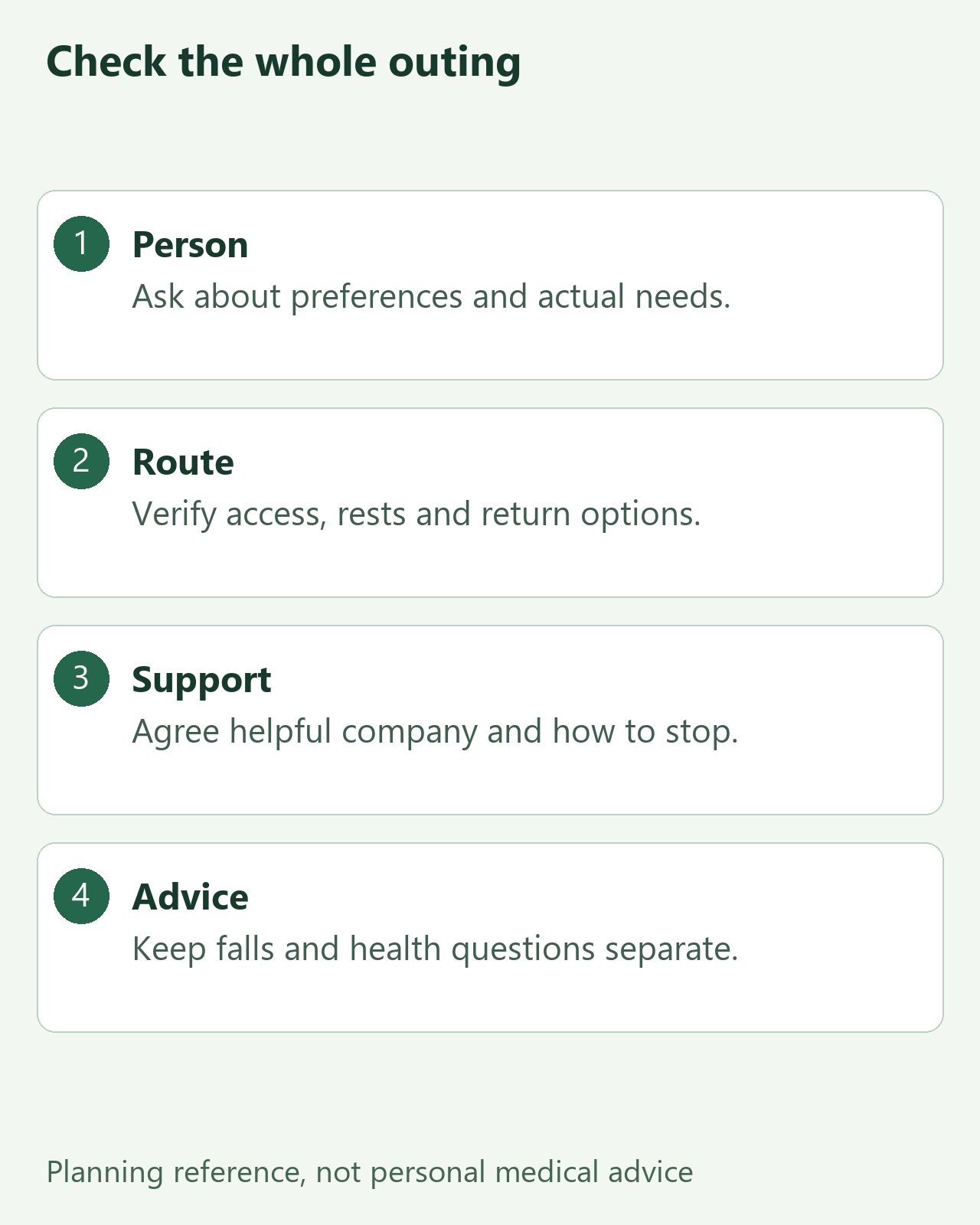
A useful walking plan starts with the person's own needs and preferences. Check the actual route, resting and return options, and any support or professional advice required, rather than assuming that age determines a fixed pace or distance.
Begin with the person, rather than an age-based walking target
Older adults differ widely in mobility, experience, health and the kind of outing they want. One person may enjoy long walks, while another needs a level route, frequent rests or assistance with transport. Neither situation should be inferred from age alone.
Ask what would make the outing worthwhile: visiting a familiar place, meeting someone, getting to a shop or spending time outdoors. Then identify the features needed to make that outing workable. The useful question is “What would help this person choose and use the route?” rather than “How far should someone of this age walk?”
NHS guidance for adults aged 65 and over encourages daily activity, including light activity, alongside appropriate aerobic, strength, balance and flexibility activities. It advises speaking to a GP first after a long period without exercise or when there are medical conditions or concerns. Individual advice can change the plan.
Check the whole route, including the journey there and back
A level path is helpful only if the person can reach it and return. Look at transport, parking or drop-off, entrances, steps, crossings and the actual route beyond the first section. A usable bus stop at the start does not confirm that the return stop is available or that someone can wait there comfortably.
Identify resting places where they are genuinely needed. Check location, access and whether seating is usable for the person; a bench on a map may be damaged, occupied or reached by steps. Toilets, shelter and opening hours can also be essential. If an essential feature cannot be confirmed, choose another arrangement rather than treating the uncertainty as a minor detail.
For parks and managed venues, use the site's own current access information and contact the venue with specific questions. The National Park Service recommends advance contact about assistance and reasonable modifications in its US parks. That supports asking the responsible venue about actual needs; it does not prove that every local route meets a universal standard.
On a narrow screen, scroll the table sideways to read all columns.
| Route feature | Question to verify | Useful evidence or next action |
|---|---|---|
| Arrival and return | Can the person reach the start and get home as planned? | Current transport, access and pickup arrangements |
| Surface and gradient | Does the full relevant section suit their mobility needs? | Venue information, direct observation or a specific access question |
| Resting places | Are suitable places available where they are needed? | Locations, access, condition and an alternative |
| Crossings and visibility | Can the route be used without rushing or unexpected obstacles? | Today's conditions and a different route if necessary |
| Facilities and exits | Are toilets, opening hours and early exits workable? | Verified current details, not a broad “easy walk” label |
Agree support without taking over the person's choices
If someone wants company, ask what support is helpful. They may prefer a companion for conversation, route finding, carrying an item or knowing how to call for help. Do not assume that accompaniment means taking control of pace, destination or decisions.
Agree how either person will stop, rest or change the outing. A companion should be willing to end the walk without persuasion. If someone needs hands-on assistance or has specific mobility instructions, use the guidance they have received; do not improvise pulling, lifting or using random furniture as a support.
Use an existing walking aid as advised. A website cannot select, fit or teach safe use of an aid for an individual. If the aid, its condition or the person's ability to use it has changed, get the appropriate advice before relying on it on a new route.
Arrange a reachable way to seek help. That may include a charged phone, a suitable personal alarm or a companion who knows the location. Check how to describe where you are, especially on a park path. Knowing a route name alone may not identify the access point emergency responders need.
Take falls and balance concerns seriously
The NHS advises seeing a GP after a fall or when you are worried about balance or mobility. A review may include balance, medical conditions, eyesight, medicines, the home environment and referral to a falls service. Walking more does not answer each of those questions by itself.
Practical fall-prevention guidance includes well-fitting footwear with grip, carrying a phone or using a personal alarm and reducing trip hazards. Follow relevant advice about support and home adaptations. Do not change medicines yourself because you suspect they affect balance; speak to a GP or pharmacist.
A recent fall, a new change in steadiness or concern about getting up and down is a reason to discuss needs before using the outing as an exercise test. A companion's presence, a shorter route or walking poles do not establish medical readiness.
Walking can sit alongside strength, balance and flexibility
Slow walking is listed by the NHS as light activity. Walking at suitable moderate effort can contribute to aerobic activity. The public guidance also includes activities for strength, balance and flexibility; an extra lap does not automatically replace them.
The NHS recommendation for older adults includes at least 150 minutes of moderate activity a week, or 75 minutes of vigorous activity if already active, or a combination, plus strength, balance and flexibility activities on at least two days. These are general recommendations for the overall activity pattern. They are not an instruction to begin with a large walk or move to vigorous activity.
If you need to choose exercises around falls, pain, illness or mobility needs, ask a qualified professional about suitable options. Keep existing healthcare advice ahead of a generic routine. A walking article can explain the different questions without assigning an exercise program.
Build familiarity without compulsory progression
For a suitable, uneventful outing, familiarity may be valuable. You can learn which time is less crowded, which entrance is easiest and whether the return arrangement works. Keeping the same route can be more useful than changing several details at once.
If an ordinary practical feature caused difficulty, identify it precisely. A resting place being unavailable calls for a different resting arrangement or route. Poor light calls for another time or setting. Neither should be treated as a personal failure or an automatic reason to increase effort.
Record the person's own experience, including what they enjoyed and what they would change. A companion's impression should not replace that account. Do not use a completed route as proof of recovery, confidence or health; confidence and physical safety are related concerns but they are not interchangeable.
End the outing when symptoms or hazards require it
Stop for concerning symptoms such as chest discomfort, feeling faint, severe breathlessness or unusual pain. Seek appropriate medical help. Sudden persistent chest discomfort, spreading chest pain or chest pain with sweating, sickness, lightheadedness or breathlessness are emergency examples in NHS guidance. Fainting while exercising also needs emergency help.
After a fall, seek emergency help if the person cannot get up or may have injured their head, back, neck or hip. Do not try to lift them yourself. Follow the emergency service's instructions and keep the person comfortable while help is arranged. Other pain, injury or feeling unwell after a fall also needs prompt medical advice.
Use your local services; the numbers in NHS sources are UK pathways. Symptoms that resolve and an easier route do not establish permission to restart. Address the relevant health concern and any route problem before planning another outing.
Examples to work through
These fictional examples illustrate choices in everyday settings.
A familiar park with an unavailable bench
Ellen chooses a park because she knows its paths, but a resting place she relies on is currently closed for repairs. She and her companion verify another accessible option before leaving. If no workable arrangement exists, they choose a different outing. Familiarity does not make a missing essential feature irrelevant, and the change is not evidence that Ellen should train harder.
A companion assumes help is needed
David wants company on a local walk. His relative starts deciding the route and taking his arm without asking. They pause to agree what David actually wants: conversation, help checking one crossing and a flexible return. Any physical assistance follows David's established guidance. Age alone does not justify taking over the outing.
A recent fall changes the question
Ruth has fallen recently and is worried about balance. Instead of using a short walk to prove that she is all right, she seeks the appropriate professional review. Her questions include the route, footwear, medicines and whether a falls service could help. A shorter path may later be practical, but it cannot substitute for addressing a new concern.
A route is usable but the return bus is uncertain
Ahmed finds an accessible path near a bus stop. Before choosing it, he checks the return service and where he would wait. A timetable change means the planned return is unreliable. He arranges an alternative or chooses another destination. Assessing the whole outing prevents an attractive path from becoming a difficult journey home.
Older-adult walking outing record
Use this optional text record for practical checks, choices and questions needing advice. Keep notes in an appropriate private place. Downloading it does not send your completed notes to this site or assess health. Do not delay necessary help to fill in a record.
Frequently asked questions
How far should an older adult walk?
There is no distance that fits everyone in this guide. Consider individual needs, activity experience, current conditions and advice, together with the whole arrival and return arrangement. A route description or age cannot establish readiness. General activity recommendations concern the broader pattern of activity, rather than a fixed first outing.
Is a gentle walk worthwhile?
Gentle walking can be light activity and a useful outing. Moderate walking is a different category. There is no need to make every trip brisk merely to justify it. Older-adult guidance also addresses strength, balance and flexibility, so consider those questions separately with appropriate advice.
Should a walking companion provide physical support?
Ask what help the person wants and follow any established guidance. Company can mean conversation or route assistance rather than hands-on support. Do not improvise lifting or pulling, and do not assume that holding an arm replaces an appropriately fitted mobility aid or professional advice.
What if someone has recently fallen?
Seek the relevant professional review, including concerns about balance or mobility. Walking a short route does not prove that the concern is resolved. After a fall, inability to get up or possible head, back, neck or hip injury requires emergency help under the cited NHS guidance; do not lift the person yourself.
Choose the next reading task
Sources and what they support
- NHS: Physical activity guidelines for older adults
Light and moderate activity, strength, balance and flexibility, and appropriate individual advice for adults aged 65 and over. Walking does not replace every activity need.
- NHS: Falls
Falls and balance concerns, professional assessment, practical prevention and help after a fall. Do not lift a fallen person yourself. UK service numbers in this source are not universal.
- NHS: Chest pain
Emergency chest-pain examples and medical advice when pain comes and goes or resolves with concern. No diagnosis or permission to restart activity is inferred; UK service pathways apply in the UK.
- NHS: Fainting
Medical review and emergency examples, including fainting while exercising. A symptom-free moment does not establish readiness to restart. UK service pathways are country-specific.
- National Park Service: Plan your accessible visit
Advance questions about assistance and actual accessible features in US national parks. This supports specific venue questions, not a claim that every route meets universal accessibility requirements.
- NHS: Shortness of breath
Adult and child breathing emergency examples, urgent advice and the need to avoid self-diagnosis. Use local emergency services; the NHS numbers are UK pathways.
General activity information based on the listed sources. Individual advice and current local instructions may be needed. Practical examples and records do not diagnose symptoms or establish medical readiness. No clinical reviewer is claimed for this article.