Practice worksheet
Walking Observation Bingo: A Printable Activity Without Step Targets
Choose an observation prompt, a description or a pass. Use the original printable nine-square card without step, pace or completion targets, and adapt participation around actual preferences, access and support.
Play without turning the outing into a target
Walking observation bingo is an optional noticing activity: choose a prompt, pause somewhere appropriate, and describe what you notice. You can use a short walk, an existing seated spot, a window view or a description you choose. The card below has nine original prompts and no step, distance, pace or completion target.
For example, “a repeated pattern” could be a fence detail, a branching plant or words in a description. You do not need to find a rare species, travel farther or photograph proof. One square can be the whole activity. A blank square can mean “not available,” “not interested” or simply “finished.”
This is a recreation idea, not a fitness test, treatment, prescribed sensory exercise or measure of attention. Completing it does not establish an exercise dose or health benefit. An ordinary walk still needs a suitable route and any individual advice you use. A seated or description-based version is a different participation choice, rather than a claim of equivalent physical activity.
The existing first-meetup checklist handles invitations, arrivals and departures. The indoor-route guide handles a physical path and stopping place. This page adds the optional observation game; its card cannot settle either planning task.
Choose the setting before the game
Use a setting that already works for the people participating. Do not select an inaccessible path because it seems likely to produce more interesting squares. Confirm relevant surfaces, crossings, facilities, current conditions and return arrangements first. The route-feature checklist keeps checked information, dates and unknowns visible.
The U.S. National Park Service advises contacting the particular park ahead of time about disability-related assistance and questions. [2] Its general commitment does not verify your entrance, seat, route, transport or information format. Ask the actual operator about the feature you need. A game labelled “inclusive” cannot supply a missing facility or support arrangement.
Ramblers advises checking the walk description, asking the leader when suitability is unclear and checking the weather. [1] On an organised walk, follow the actual leader's arrangements; do not introduce game pauses or change the route without agreement. For an informal outing, agree where pausing and finishing will work before starting.
Keep cards, phones and writing separate from moving through a crossing, navigating a kerb or managing another immediate task. Pause only in a place that works for you and does not block others. If stopping there is unsuitable, keep moving as appropriate and leave the square unfinished. The activity provides no reason to look away from the route.
Use the original nine-square card
The numbers identify prompts, not scores. Start with any one. An optional line consists of three squares across a row, down a column or along a diagonal; choosing such a line is only a game convention. You can also ignore lines and use a single prompt.
| First square in row | Second square in row | Third square in row |
|---|---|---|
| 1. A colour | 2. A line | 3. A repeated pattern |
| 4. A change | 5. A sound or description | 6. Light or its description |
| 7. A living thing | 8. A made object | 9. Your own question |
Mark a square with your own word or note rather than a compulsory tick. “Described,” “changed” and “pass” can be as useful as “noticed.” There is no race, leaderboard, fastest finisher or penalty for a different card. A person choosing not to play can still join an otherwise appropriate outing.
The following notes explain the prompts so that the printable image is not the only way to use the card.
- A colour. Name one colour, or use a chosen description of it.
- A line. Notice a curved, straight or branching line.
- A repeated pattern. Describe a repeated feature without needing to count it.
- A change. Something differs from an earlier observation.
- A sound or description. Notice a sound, or choose a description instead.
- Light or its description. Notice light, shade or a chosen account of it.
- A living thing. Observe a plant or animal without approaching or disturbing it.
- A made object. Describe an ordinary object without identifying a person.
- Your own question. Choose a question that fits how you want to participate.
Keep observations modest. “A branching shape” does not require knowing a tree species. “A bird-like sound” can remain uncertain. The square asks for a description, rather than a confident identification that the available evidence cannot support.
Use the participation mode the person chooses
Ask which format and setting the person wants instead of assigning an alternative based on their appearance or an assumed diagnosis. Options below are original suggestions to discuss; they do not certify accessibility, provide mobility instruction or replace the support someone normally uses.
| Choice | Possible way to use a prompt | Check with the participant |
|---|---|---|
| Ordinary route with pauses | Notice a feature at an agreed appropriate stopping place. | Route, pauses, attention, return and usual support actually work. |
| An existing seated location | Use what is available from that location; do not travel to complete missing squares. | The seat or usual position, approach and information are usable. |
| Description-based participation | Use a companion’s agreed description, available text or another description you choose. | Preferred detail, communication format and whether sharing is wanted. |
| One prompt, rewritten or passed | Change “sound” to another chosen description, or leave the square unused. | The person wants this change; there is no obligation to keep playing. |
For a person who prefers spoken information, a companion can read one chosen prompt and offer a brief description with permission. For a person who prefers text, use the downloadable record or their chosen format. Do not assume a screen reader, interpreter, companion or device is available merely because the game permits it.
A stationary observation does not require standing, reaching, leaning or moving an aid to obtain a better view. Use an existing position that works for you, your usual assistance and any individual instructions. If the setting does not support the intended participation, choose another arrangement or omit the game.
Touch, smell, closed eyes and balance challenges are not required alternatives. Do not handle unknown plants, approach wildlife or ask someone to navigate with their eyes closed to make a square “more sensory.” A word-based replacement can keep the activity with the person's preferences.
Agree a shared game without competition
Before offering cards, ask whether people want the game at all. Explain that prompts may be changed and passing is ordinary. Choose individual notes, one shared description or no written record. People do not need to disclose health, literacy or sensory information to justify a choice.
An original invitation draft is: “Would anyone like an optional noticing prompt at our agreed stops? You can use the card, choose a description, change a square or pass. We will keep the existing route and finish arrangement, and no one needs to complete a line.” This wording is a suggestion, not a message being sent or an event already organised.
If a shared square involves different observations, keep both rather than holding a vote on whose senses were correct. One person may describe a branching shadow while another notices the texture of the path in a companion's account. A common prompt does not require identical access or perception.
For outings involving children or organised groups, the actual responsible adults and organisation must settle supervision, safeguarding and participation arrangements. This card supplies none of those procedures. Do not send children or other participants away to search for a square, and do not substitute a game for the group-accounting plan.
Leave places, wildlife and people undisturbed
Observation is sufficient. NPS Leave No Trace guidance says to leave natural objects as found, observe wildlife at a distance without following or feeding it, and respect other visitors. It also stresses preparation and local regulations. [3] Those principles support a low-impact game; they are not a route-specific permission.
Do not pick a leaf, move stones, leave marks or build a trail marker to fill a box. Do not approach a nest, feed an animal or follow wildlife for a photograph. If an interesting feature is beyond a barrier or outside the permitted route, leave it there and change the prompt.
A camera is optional. Ramblers recommends permission before sharing photographs of people. [1] The game does not need identifiable bystanders, homes, number plates or private conversations. “A made object” can be a generic bench or an ordinary pattern without recording who used it.
Keep discussion considerate of other people and the place. A quiet public setting may need a quiet description or a later conversation. Respect local access rules and closures even when the card is unfinished. Do not turn “find something new” into a reason to enter private land or disturb a habitat.
Try two fictional examples with different participation
Example one: an ordinary park stop. Three friends have already agreed a suitable route and a stopping place. One chooses “a line” and describes a curved railing. Another uses “a repeated pattern” for its repeated uprights. The third passes and continues the conversation. Nobody leaves the checked route to search for a living thing, and no line of three is required.
Example two: a chosen description from an existing seated spot. A participant asks a companion to read “a change.” The companion describes how light on a nearby wall differs from an earlier moment. The participant asks one question, records “description used,” and finishes the activity. This is a description-based choice, not a claim that their access has been assessed or that they completed a walking session.
Both examples are invented. Their useful result is a participation choice and a specific description. They do not demonstrate improved mood, attention, fitness, mobility or future attendance. In a real outing, a person might dislike the format, prefer no description or decide to stop earlier. Keep that feedback without treating it as failure.
For the next version, change only what would make the game more usable: fewer prompts, clearer wording, a preferred format, an appropriate pause or no game. You do not need to increase the route, time or number of completed squares.
Seven checks on optional play
These original fictional cases check the rules and boundaries of the activity. They do not rate a person's health, access needs or ability.
Case 1
Only one square is noticed before the agreed finish. Must the walk continue?
Show answer and explanation for case 1
No. Finish according to the actual outing arrangement.
The card has no completion target; an unfinished row creates no extra walking obligation.
Case 2
A needed route feature is unverified. Does offering a seated or description option certify accessibility?
Show answer and explanation for case 2
No. Resolve the actual access question or change the arrangement.
A participation idea does not provide a usable entrance, location, communication format or required support.
Case 3
A bird beyond a barrier would fill a square. Should someone follow it?
Show answer and explanation for case 3
No. Leave it undisturbed and use another prompt or pass.
The game does not override barriers, local rules or distance from wildlife.
Case 4
Someone prefers text and wants to replace the sound square. May they do that?
Show answer and explanation for case 4
Yes. Use their chosen wording or pass without penalty.
The prompts are optional; no specific sense or format is required to earn participation.
Case 5
A participant chooses descriptions from an existing seated place. Is a brisk walking dose established?
Show answer and explanation for case 5
No. Record the participation choice without inventing an exercise amount.
A recreation card does not measure movement intensity, distance or equivalent activity.
Case 6
A completed line is photographed with identifiable bystanders. Is public sharing required?
Show answer and explanation for case 6
No. The game needs no photo proof; respect people’s privacy and permission.
A generic written observation can serve the prompt without publishing someone else’s image or details.
Case 7
A person feels faint while a square remains blank. Should they keep going more slowly to complete it?
Show answer and explanation for case 7
No. Stop and obtain appropriate help.
The game supplies no symptom diagnosis or permission to restart with a reduced target.
Print or copy your card and finish when you choose
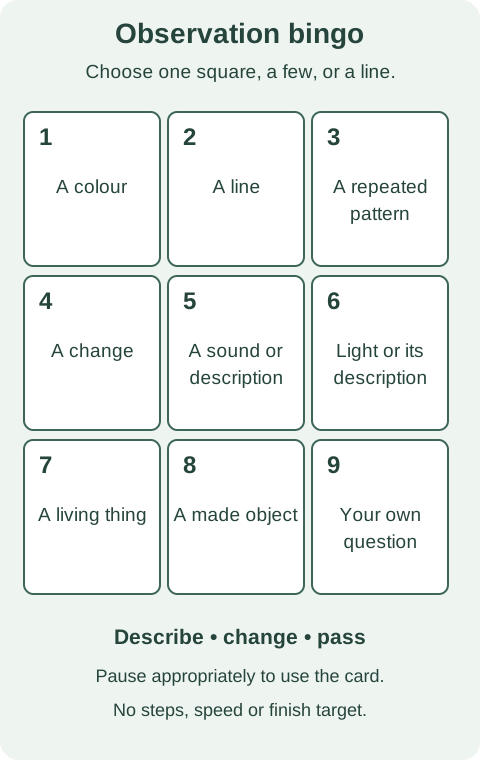
Open the original printable card (SVG) or Open the plain-text card, adaptation notes and seven explained checks (TXT). You can copy the text into a preferred format and enlarge it. Browser print controls are available above; use your own print settings for paper size and scaling.
WALKING OBSERVATION BINGO — ORIGINAL NINE-SQUARE CARD
1 A colour | 2 A line | 3 A repeated pattern
4 A change | 5 A sound or description | 6 Light or its description
7 A living thing | 8 A made object | 9 Your own question

Choose any square, a few squares, or an optional line of three.
Notice directly, use a description you choose, replace a prompt, or pass.
No required steps, distance, speed, number of finds or time limit.
Pause safely to use the card. Leave people, wildlife and objects undisturbed.

MY OPTIONAL VERSION
Setting and participation choice:
Prompt I choose / wording I change:
Observation, description used, or pass:
Another possible description, if useful:
What I would keep or change next time:
Unfinished squares create no obligation to continue.
The NHS walking guide discusses broad walking benefits and gradual distance changes for inactive people who can walk. [4] This optional observation activity does not measure briskness, distance or exercise intensity and supplies no minimum walking dose. A seated or description-based game is not automatically counted as a walk.
Stop for concerning symptoms and obtain appropriate help; do not continue to finish a row or treat a reduced target as permission to restart. Personal exercise questions need appropriate qualified advice. A changed route, weather concern or unavailable support also takes priority over the card. Use the beginner preparation and stopping checklist for the broader questions, and the group weather plan when applicable.
Finish by asking, if wanted, “Which prompt or format would you keep?” No answer, no written note and no completed line are all possible endings. The page does not collect answers or award a score. For the wider outing, return to planning a social walk.
Sources and further reading
- Ramblers: What to expect when you join a group walkWalk descriptions, leader questions, actual group arrangements, weather checks and permission before sharing photos of people.
- National Park Service: Accessibility — Plan Your VisitContact the particular park before visiting about disability-related assistance; no verification of our settings or card.
- National Park Service: Leave No Trace Seven PrinciplesLeave natural objects, observe wildlife at distance, respect other visitors and local rules. No route-specific permission.
- NHS: Walking for healthGeneral walking context and gradual changes for people able to walk; the card does not measure intensity or activity dose.