Practical guide
Planning a Road Section on a Group Walk
Check pavements, the Highway Code’s ordinary and large-group rules, crossings and look-out arrangements. Includes a fictional rejected plan and an original worksheet.
On this page
Treat the road section as its own route decision
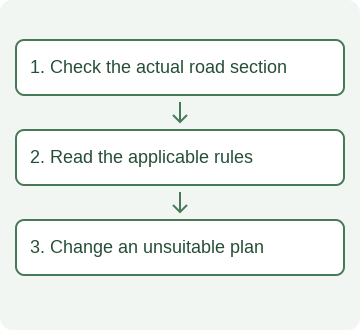
A short road link needs its own plan even when most of the walk is off-road. Identify where the group enters traffic space, whether a pavement or footway is provided, where people cross, and where everyone can wait without obstructing others. If those arrangements do not work for the actual group, change the route.
The Highway Code’s pedestrian rules apply in Great Britain. They distinguish ordinary no-pavement walking from organised walks or parades involving large groups. Read the current rules for the actual situation instead of reducing them to one universal instruction about the side of the road.
The Code gives no numerical definition of “large” in Rule 5. This guide does not invent one or recommend dividing a group to evade a rule. If the organiser cannot determine and manage the appropriate arrangement, seek competent local or organisational guidance and use a suitable alternative.
Use the pavement and read the correct no-pavement rule
On a small screen, swipe inside the table, or focus it and use the arrow keys.
| Rule | Published guidance | Planning implication |
|---|---|---|
| Rule 1 | Use pavements and footways where provided; remain aware and considerate. | Check the complete pedestrian route, its space and points where it ends. |
| Rule 2 | With no pavement, keep to the right to see oncoming traffic; be ready for single file and keep close to the side. | Assess narrow sections and poor light; the source also discusses sharp right-hand bends. |
| Rule 5 | Large organised walks/parades use a pavement if available; otherwise keep left, with specified look-outs and visibility arrangements. | Do not apply the ordinary no-pavement instruction indiscriminately to a large organised group. |
| Rule 7 | Choose a suitable crossing place and use the Green Cross Code. | Check visibility in all directions and room to reach the far-side pavement. |
| Rule 18 | At crossings, check traffic has stopped before crossing; do not loiter on a crossing. | Plan a suitable waiting/regrouping place away from the crossing itself. |
Rule 2 says it may be safer to cross well before a sharp right-hand bend and cross back afterwards. That is not an instruction to step into traffic automatically at every bend. A real crossing still needs the checks in the pedestrian guidance; an unsuitable bend may require a different route.
Rule 5 specifies front and rear look-outs wearing fluorescent clothes in daylight and reflective clothes in darkness. At night the front look-out shows a white light and the rear a red light; people on the outside also carry lights and wear reflective clothing. Read the full source for the actual plan. A phone screen, a vague “bright jacket” message or a generic backmarker title does not establish that arrangement.
These instructions do not turn the road into a protected event route. A volunteer leader does not become an authorised person who can stop traffic. Rule 29 identifies crossings controlled by a police officer, traffic warden or school crossing patrol; do not infer that role from leading a walk.
Source: [1]
Plan crossings and the place to regroup
Before confirming the walk, check the pedestrian crossing arrangement and the space on both sides. Rule 7 advises using a nearby crossing and choosing a place where you can see clearly and reach the other side. Avoid treating a point on a map as proof that a group can wait or cross there.
Explain how people will follow the actual crossing signals and checks. A walker must not follow the first person into the road when the signal or traffic situation no longer permits starting. Different crossings have different instructions; for example, the Code distinguishes a pelican’s flashing green phase from a puffin’s signals. Use the current rules for the crossing actually present.
Identify a far-side place where people can wait clear of the crossing and moving users. An island may be a separate crossing stage, not a place to hold the whole group for a briefing. Check that the plan fits the actual available space and participants, without inventing a universal capacity from a photograph.
Pedestrian priority does not guarantee that a driver has seen you or stopped. At a zebra crossing, the Code says to give traffic time to see and stop and to wait for traffic to stop from both directions or for the road to be clear. Keep looking and listening. Do not use “we have priority” as the group’s entire plan.
Source: [1]
Agree the roles before reaching traffic
Discuss the road section before the group reaches it. Agree who explains the plan, who checks that the rear has received it, what look-out roles are required for the actual group, and where the group reconnects. Confirm that the people assigned understand and can perform the jobs.
A backmarker normally helps keep group contact; the road look-out requirements are a specific additional question. If one person carries both roles, check whether those tasks are compatible in that setting. Do not simply relabel an unbriefed participant as the required look-out.
Give the participant-facing instruction in plain language using the actual crossing and waiting place. For example: “Use this crossing’s signals and check the traffic; do not follow someone who has already started if you cannot start safely. Once across, continue to our checked meeting space.” This original wording still needs an appropriate real arrangement; it is not approval of an unknown road.
Use the leader-role agreement guide for the wider communication plan. Download the original road-section planning record (TXT) to keep rule, crossing and role questions together.
Source: [1]
Work through a fictional unsuitable crossing
Fictional example: a social walk uses a pedestrian crossing to connect two park paths. The organiser initially marks the crossing as a convenient regrouping point. During the recce, they find that the far-side footway is narrow and its usable space is already shared with a busy entrance.
The crossing exists, but the proposed group waiting arrangement has not been established. “The leader will hold traffic” is not a solution: a volunteer has not acquired an authorised traffic-control role. Nor does sending the first walker across prove that everyone behind can start before a signal changes.
The organiser checks an alternative pedestrian route and suitable far-side meeting space before confirming the event. If no workable arrangement is established, they change or postpone that route choice. They explain the actual confirmed plan rather than keeping the original distance at the cost of an unresolved road section.
This example demonstrates a missing planning condition. It supplies no real road inspection, traffic measurement, safe crossing time or event permission. The recce record should retain what was observed, the uncertainty and who needs to resolve it.
Source: [1]
Check three road-section mistakes
These fictional checks concern the source distinctions and the proposed arrangement.
Case 1
A leader says every no-pavement group must always walk on the right. Is that a complete reading of the Code?
Show answer and explanation for case 1
No. Read Rule 2 alongside Rule 5 for the actual group.
Rule 5 gives different guidance for large organised walks/parades. It contains no fixed numerical cutoff in the source read here.
Case 2
The first walker crosses on the green signal. May everyone else follow after the signal changes?
Show answer and explanation for case 2
Not automatically. Each person follows the actual crossing’s instructions and checks.
Starting permission, traffic and available space matter. Being part of a group does not extend a signal or guarantee that traffic has stopped.
Case 3
The far-side space cannot accommodate the proposed regroup. Does assigning a backmarker settle it?
Show answer and explanation for case 3
No. Establish a suitable arrangement or change the route.
A role assignment does not create physical waiting space, traffic-control authority or protection from vehicles.
Sources and further reading
- GOV.UK: Highway Code, rules for pedestrians 1–35Great Britain pedestrian guidance, including pavements, ordinary and large-group no-pavement walking, visibility and crossings. Rules 2 and 5 give no numerical large-group cutoff.
- Ramblers: The Highway Code for walkersAn explanation of the Highway Code for walkers, with links to the primary pedestrian rules. Use the current rules for the actual road and group.