Practical guide
Recce a Route Before Leading a Group Walk
Check the whole intended outing, turn observations into route changes and keep a recce date separate from current conditions. Includes an original workflow, worked findings and three fictional checks.
Decide what this recce must establish
A recce is a reconnaissance of the walk you intend to lead. Start with the actual route, direction, start, finish and group arrangements. Check whether the people responsible have the knowledge and skills for that setting. A familiar short local walk and a remote route need different preparation; neither becomes appropriate simply because you have downloaded this note.
The Ramblers handbook strongly recommends a recce when planning a walk. It identifies timing, rest stops, points of interest, risks and accessibility issues as useful findings. Its checklist suggests doing the recce close to the walk date where possible. These are planning recommendations, with no universal number of days that makes a check current.
Write down the decisions you need to make: can the proposed return work, where can the group pause, what will newcomers need to know, and which unknown would change the route? Seek experienced help or choose a simpler appropriate outing when the proposed check exceeds your own skills.
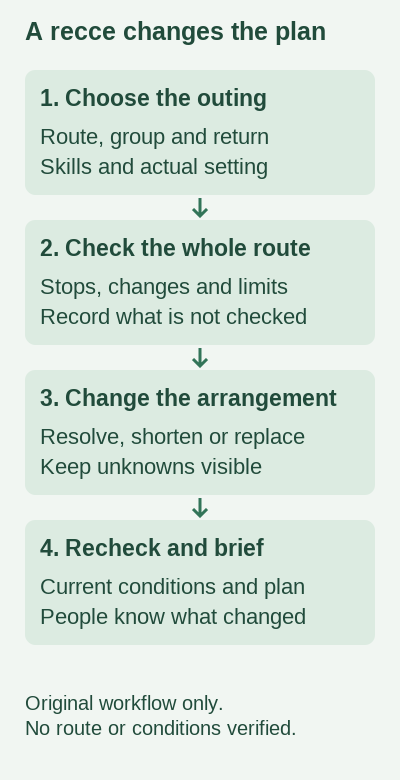
Check the route you actually intend to lead
Follow the selected route and its intended direction only where doing so is appropriate for the person carrying out the recce. Include the meeting approach, return and relevant facilities. Checking the first path from the gate does not establish the condition of an unchecked later section.
Look for features that matter to the outing: junctions, crossings, gates, changed surfaces, rest places, toilets, restrictions and alternatives. Use the route-feature checklist for precise access questions. Keep an observed detail separate from a conclusion about every participant: “three steps at the return exit” is useful information; “everyone can manage them” is an unsupported assumption.
Record the exact place and date of a finding. If you cannot establish an essential feature, ask the land manager or change the plan. Do not take an unchecked shortcut to make the route work. A recce is a planning visit, not a reason to ignore current warnings, restrictions or your own limits.
Separate timings, stops and the return
Separate moving time from pauses, briefing, regrouping, facilities and the approach back to transport. A solo elapsed time is information about that visit; it does not predict the group's pace or needs. State any extra duration as an assumption for discussion rather than a measured result.
In a wholly fictional plan, an organiser allows 35 minutes for the first section, 10 for a pause, 25 for the return section and 5 for the approach back to the meeting point. That is 75 minutes in total. It is not 60 minutes, which would omit the pause and approach. Every duration here is invented; real route observations and the group's arrangements determine whether the plan works.
A proposed early exit needs the same attention as the main route. Where does it actually lead, what features does it involve and how would somebody leave with agreed support where wanted or needed? A dotted line on a map does not provide a checked return. For participants using transport, use the journey-and-walk guide to connect the finish to their actual services.
Work through findings that change the plan
On a small screen, swipe inside the table, or focus it and use the arrow keys.
| Finding | What it establishes | What should change |
|---|---|---|
| Return gate observed with steps | A feature of that gate on the recce date | Do not promise a step-free return; confirm another usable route before inviting people who need one. |
| Toilet listed but closed during the visit | It was closed at the observed time; future hours unresolved | Ask about the event time; retain uncertainty or select a plan with confirmed needed facilities. |
| Rear of the proposed group loses contact at a bend | The chosen communication arrangement has a gap in the example | Change the arrangement with the responsible helpers; do not assume the backmarker can catch up. |
| Solo visit takes less time than the draft group plan | One person completed that visit in those circumstances | Keep group pauses and pace assumptions; do not replace the plan with a fastest solo time. |
These are original invented findings, not observations from a real route. For each real finding, retain what was checked, what remains uncertain and the resulting decision. If a needed alternative is unresolved, the outcome may be a different or postponed walk.
Use other information when a recce is not possible
The handbook allows planning from maps, guidebooks, existing routes, blogs and people with local knowledge when a recce is not possible. It also stresses understanding the terrain and keeping preparation proportionate. This does not make an old description equivalent to current first-hand observation.
Source: [1]
Identify each source and its date. Ask experienced local people about the actual route and relevant changes, and verify essential details through the appropriate operator. Say which sections you have not checked. If the available information and skills cannot support the outing, choose another appropriate plan; “no recce possible” is not an obligation to lead it anyway.
The purpose is to resolve the decisions that affect this group, not to collect a maximum number of documents. A detailed map cannot confirm today's toilet opening or replace the leader's ability to navigate the chosen setting.
Recheck and brief the changed plan
Review the forecast, warnings, restrictions, facilities and any new information on the event day. The handbook calls for reviewing plans again and adapting when circumstances change. A successful recce describes a past visit; it does not guarantee present surfaces, phone reception or transport.
Brief the participants on the current route, pauses, return and relevant changed arrangement. Use the first-meetup guide for arrivals and the group's actual contact and departure process. Follow appropriate local help procedures for immediate concerns; this page does not teach rescue or clinical care.
Download the original recce findings note. Use only the fields that affect your decision, and leave an unresolved feature visibly unresolved.
Case 1
An organiser checked only the outward section. Does that establish the proposed return is suitable?
Show answer and explanation for case 1
No. Keep the return unverified until its relevant features and arrangements are checked.
The selected outing includes the return and facilities, not merely the first part of the route. Change the plan if an essential question cannot be resolved.
Case 2
The fictional allowances are 35, 10, 25 and 5 minutes. What is the whole planned duration?
Show answer and explanation for case 2
75 minutes in the fictional model.
Add all four parts:35+10+25+5. These assumed durations do not predict a real group pace or guarantee a transport connection.
Case 3
A dry-weather recce was completed earlier. Does it settle today’s changed surface and closure information?
Show answer and explanation for case 3
No. Recheck the current conditions and revise the plan.
The date and scope of an observation matter. Current warnings, restrictions and participant arrangements may require a different outing.
Sources and further reading
- Ramblers: The Walk Leader Handbook (December 2025, version 1.3)Pages 7–9, 15–16. Organisation-specific walking guidance; no route or event approved here. Original examples and diagrams are independent.
- Ramblers: Walk Leader Checklist (December 2025, version 1.3)Pages 4–5. Practical reminders in the Ramblers context; not a completed training course or emergency protocol.
- Ramblers: Writing a walk descriptionShare accurate terrain, pace, facilities and meeting information with walkers. No route or event verified.
Record why each route segment can be used
For an England or Wales outing, distinguish public rights, permissive conditions and Open Access information alongside the physical recce.
Checking Group-Walk Route Access in England and WalesReview a Scottish event alongside other site users
For an organised Scottish outdoor event, a route visit is only one part of checking spectators, nearby events, facilities, seasonal operations and environmental effects.
Check Scottish land use before fixing the route
For a Scottish outing, a physical route visit sits alongside farmyard access, crop-field conduct and the land-manager discussion for a class-learning visit.
Recheck the familiar route when seasonal activity changes
Use typical countryside activity as a prompt for current section-by-section evidence, then revise the actual outing plan.