Practical guide
Walk Leader, Backmarker and Co-Leader: Agree the Roles
Choose helpers for the jobs they can perform, agree how front and rear stay connected, and confirm responsibilities when the plan changes. Includes an original role diagram, worked agreements and three fictional checks.
Choose helpers by the job they can do
Before departure, ask what help this outing needs and who has agreed to provide it. Route knowledge, leading a group, noticing a communication gap and assisting with the group's organisation are different jobs. A name on a list does not establish availability or competence.
The Ramblers handbook recommends working as a team and leading within actual capabilities. Its larger-group guidance describes support from a co-leader or backmarker, including an experienced group member who is willing to help. The decision depends on the setting and people; it does not turn every volunteer into a trained leader or qualified first aider.
Source: [1]
Talk through the tasks rather than saying “you'll help at the back.” If no suitable person can cover a necessary job, change or rearrange the walk. Someone who wants to participate as an ordinary walker can decline an additional responsibility.
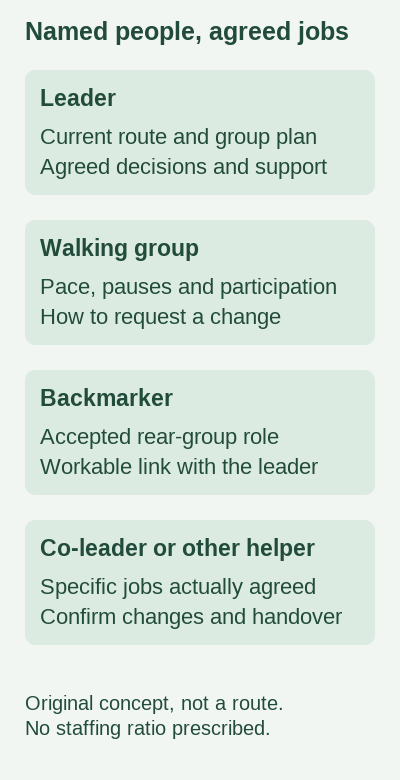
Agree front, rear and shared responsibilities
On a small screen, swipe inside the table, or focus it and use the arrow keys.
| Role in the example | Explicit agreement | Limit to check |
|---|---|---|
| Leader | Knows the selected route and coordinates the current group plan | Must have the skills and support appropriate to the actual outing. |
| Backmarker | Accepts the rear role and maintains the agreed link with the leader | Being physically last is not acceptance of the job or proof of reliable contact. |
| Co-leader | Accepts specified support tasks and knows when to coordinate a change | A title does not establish which decisions or skills the person supplies. |
| Participants | Know how to request a pause and tell the relevant host before leaving | They are not automatically responsible for an improvised search or clinical care. |
These are invented examples for agreeing responsibilities, not an official job specification. The Ramblers group-size page describes a backmarker as someone who stays at the back so people are not left behind, and mentions a middle marker as another possible support. Use your organisation's actual arrangements where they apply.
Source: [3]
Keep contact workable for the actual route
The Ramblers checklist says to keep in sight or communication with the backmarker at all times. Discuss how that will work on your selected route, including bends, junctions, noise and any known signal limitation. “We both have phones” does not establish that messages can pass where and when they are needed.
Source: [2]
Agree how a rear-group request reaches the leader before it becomes a catch-up problem. Use an arrangement the responsible people understand and can carry out. If the proposed link cannot work, choose a different group arrangement or route. This page does not prescribe radio frequencies, hand signals or navigation procedures for unfamiliar terrain.
Keep contact details through the appropriate private arrangement. A public invitation can identify the organiser's contact route without publishing everybody's personal details. For unresolved whereabouts or an immediate concern, use the group's actual local help process; an unanswered message is neither proof of injury nor proof that somebody has gone home.
Use regrouping to check people and rest
Agree the relevant regroup points before departure and check people through the actual accounting method. The checklist calls for regular headcounts, check-ins and breaks. It supplies no universal five-minute interval or one group size that suits every route.
Source: [2]
A count and a rest opportunity answer different questions. If the front walkers move off as the last walker arrives, the rear group may have had no pause. Use the shared-pace guide to agree a manageable pace and pauses without pressuring people to catch up.
A co-leader and backmarker should know who is carrying each agreed job at a stop. Avoid simultaneous assumptions such as “the other helper is accounting for people.” Check the responsibility when the group changes rather than treating a correct number as a complete picture of everyone's arrangements.
Plan a role handover before somebody leaves
If an appointed helper needs to finish early, discuss the change with the leader before separating. Confirm whether another suitable person accepts the job and understands the current arrangement. If no replacement is available, the walk may need to change or finish through a workable agreed return.
In a fictional example, Bea accepts the backmarker role for the shared circuit only. At the return point, she wants to leave and others want another circuit. Her original agreement does not extend automatically. The group must make a fresh role and departure arrangement before continuing.
A handover should cover the current group, route, communication, remaining plans and unresolved concern. It is not an occasion to disclose somebody's private health information to the whole group. Use the first-meetup guide to distinguish an agreed departure from unaccounted-for absence.
Work through three changed arrangements
When conditions or people change, reassess the actual arrangement. The handbook advises flexibility and putting safety first even when walkers want to continue. An agreed role structure should help the group adapt; it must not become a reason to keep an unworkable walk going.
Source: [1]
Download the original leader-and-helper agreement note. It records jobs and contact limits, not qualifications or emergency instructions. Choosing who can cover the jobs is separate from the number of people available to help.
Case 1
The last walker has not agreed to help lead. Can the organiser label them the backmarker without asking?
Show answer and explanation for case 1
No. Confirm a willing, appropriate person and the actual responsibilities.
Physical position does not establish an accepted role, skills or a workable connection with the leader.
Case 2
Bea agreed to backmark the first circuit and now wants to leave. Does the role automatically continue for the optional circuit?
Show answer and explanation for case 2
No. Agree a handover or change the continuing walk before separating.
The original agreement has a scope. A replacement must actually accept the job and understand the remaining arrangement.
Case 3
The group count is correct, but front and rear cannot use the agreed contact method. Is the arrangement fully resolved?
Show answer and explanation for case 3
No. Address the communication gap and adapt the plan.
Accounting for people and keeping the leader/backmarker connection workable are different needs. A headcount does not repair failed communication.
Sources and further reading
- Ramblers: The Walk Leader Handbook (December 2025, version 1.3)Pages 5, 7, 11–12, 15–16. Organisation-specific walking guidance; no route or event approved here. Original examples and diagrams are independent.
- Ramblers: Walk Leader Checklist (December 2025, version 1.3)Pages 4, 6. Practical reminders in the Ramblers context; not a completed training course or emergency protocol.
- Ramblers: Managing group sizeBackmarker and middle-marker support; actual route, conditions and experience determine the arrangement.
Plan the road section and its specific roles
A road look-out arrangement is a separate planning question from ordinary group contact. Check the applicable pedestrian guidance, crossings and waiting space.
Planning a Road Section on a Group Walk