Rainy-Day Movement for Kids: Indoor Games and Simple Rules
Revised · General activity information
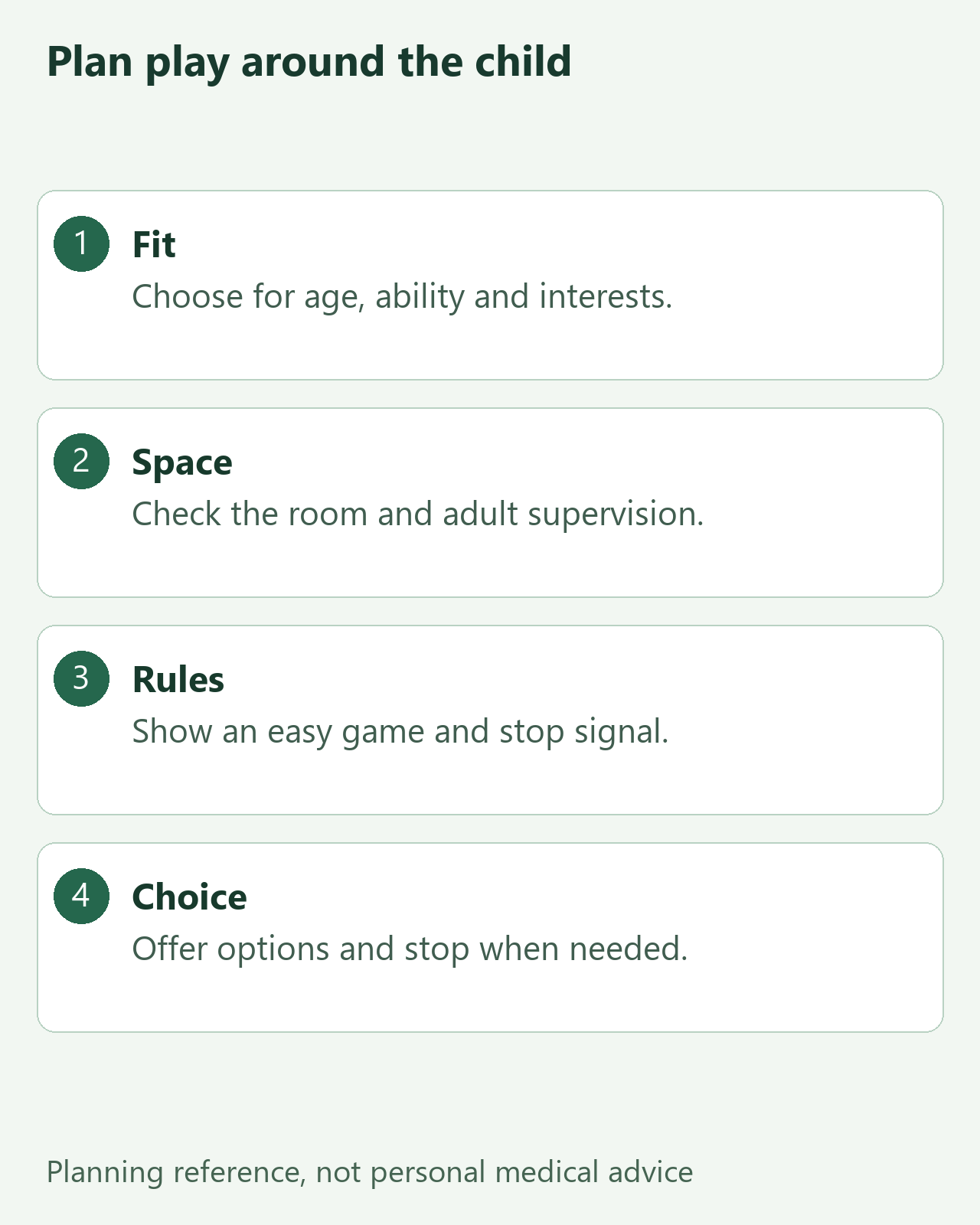
For a rainy day at home, choose a game that fits the child and the available space. Keep rules easy to understand, offer ways to join or stop, and supervise the actual play rather than turning it into an adult workout or a target to finish.
Choose a game for this child, age and room
This guide is for adults planning indoor play with school-age children, generally aged five and over. It offers original practical game ideas rather than a tested exercise program. Choose according to the child's age, ability, experience, interests and any individual advice. A game that fits one child may not fit a sibling.
Babies, toddlers and preschoolers need different activities and supervision decisions. The NHS under-five guidance distinguishes those age groups; do not treat the school-age games here as an infant or toddler routine. In a mixed-age household, supervise and plan separately where needed rather than asking everyone to copy the oldest child.
NHS guidance recommends varied activity across the week for children and young people. An indoor game can be one opportunity to move, but it does not automatically provide the full activity pattern or reach a particular intensity. Keep play about participation, enjoyment and suitable movement rather than body size, calories or a score.
Make the space ready before starting the game
Choose an area where an adult can supervise. Check the floor, nearby furniture and the route into the room. Rainy-day entrances may have wet shoes or clothing; deal with water and obstructions before using that area. Keep doorways and normal household access available.
Move loose objects and trailing leads out of the play space, and avoid games around hot surfaces, cooking, stairs or an open exit. Do not use furniture as a climbing course. A soft object is still an object that can obstruct movement, so consider its size, use and where it will end up.
Agree a simple stop word or signal before beginning. Show it and practice an ordinary pause so everyone understands what happens. It should mean stop moving and listen, not hold an awkward pose or compete to stay still. The child can also say they want to stop or choose another activity.
Offer a suitable seated or smaller-movement option when it helps participation. Follow any individual support guidance. Do not reposition, lift or physically guide a child in a way that is outside your knowledge or their established care advice.
Game 1: Copy my comfortable movement
Stand or sit where each person has their own clear space. One person leads a simple comfortable movement, such as moving their hands in a small pattern, reaching within an easy familiar range or making an unhurried step if stepping is appropriate. The other copies it, then you swap leaders.
Keep the movement visible and easy to stop. Avoid jumps, fast pivots, balancing contests or asking anyone to stretch farther. The rule is “choose a move that works for both of us,” so the leader changes it if their partner cannot or does not want to copy it.
For a quieter version, both people can sit appropriately and copy hand patterns. For a child who prefers fewer instructions, show one move and repeat it before changing. Copying accuracy is not a measure of fitness or behavior.
Game 2: Make and answer a rhythm
Use claps or comfortable hand taps to make a short rhythm. The child answers with the same rhythm or invents a different one. Keep turns flexible; an adult can start with a simple example, then let the child lead.
There is no need for loud music or equipment. A seated version can use comfortable hand movements. In a quiet household, use gestures instead of sounds. If a child finds the pattern frustrating, reduce the rule or let them choose a new pattern rather than treating a missed beat as an elimination.
This is a playful movement idea, not a promise of a developmental or therapeutic result. Choose movements the child can use comfortably and adapt communication to their needs.
Game 3: Move, pause and choose
Agree a familiar comfortable movement that fits the room, such as gentle steps in a clear area or a seated hand pattern. An adult gives a visible or spoken pause signal. Everyone stops comfortably, without balancing on one leg or holding their breath. Then the child chooses whether to repeat, change the movement or finish.
If music is used, keep it low enough for the stop signal and supervision. The pause is an opportunity to check the space and the child's wishes. It is not a contest to stand motionless for the longest time, and nobody is out for needing a break.
For a noise-sensitive child, use a predictable visual signal instead of suddenly stopping loud music. For a small shared room, keep each person in their own area so movement does not turn into a chase.
Game 4: Find a nearby color or shape
The adult identifies a visible nearby color or shape in the permitted area. If walking there is suitable, the child can move calmly toward it and show what they found. If walking is not the chosen option, they can point, describe it or make a comfortable movement to represent it.
Set the boundary before the game: no climbing, running into another room or reaching for items outside comfortable access. Use visible features rather than hiding objects in cupboards or near cords. The purpose is a shared choice of movement, not a timed search.
Let the child choose the next color or shape. A sibling can have a different way to participate. A pointing version changes the activity demands and should not be counted automatically as the same physical activity as walking.
Two more options when they fit the household
On a narrow screen, scroll the table sideways to read all columns.
| Game | Simple setup and rule | Quiet or adapted choice |
|---|---|---|
| Tell a movement story | Use a familiar story and choose comfortable gestures for parts of it; keep movement in each person's clear area | Use seated hand gestures or let the child tell the story while someone else demonstrates |
| Dance in your own space | Choose familiar comfortable movements with feet on the floor when standing is suitable; pause on the agreed signal | Use a seated rhythm, quieter music or a visual beat, with no requirement to copy the same movement |
The choices are options rather than a circuit. You can use one game, switch when interest changes or finish without completing the list. If the room, support needs or the child's wishes make an option unsuitable, choose something else or stop.
Keep mixed ages and abilities out of a competition
An older child may want to lead, but should not become responsible for supervising a younger one. The adult remains responsible for the setting, rules and response to concerns. Explain that a useful leader chooses a movement others can participate in and respects the stop signal.
Offer choices without requiring identical movement. One child may step, another may use a seated movement and another may observe before joining. Avoid comparing speed, flexibility, body size or how long someone can continue. The participation option should fit the person rather than make them prove they can match someone else.
If a child has a health condition, disability, injury or specific care instructions, use the relevant advice. NHS guidance says activity should suit age, ability and experience and advises medical input for health conditions. Public recommendations also distinguish some disability contexts; a generic adult timer should not decide a child's activity needs.
Pause ordinary frustration; stop for symptoms or hazards
If a game becomes confusing, overwhelming or unwanted, pause it. Offer fewer rules, a quieter choice, watching instead of joining, or finishing. You do not need to frame stopping as a failure or a consequence for behavior.
A symptom or a safety hazard is a different issue. Stop activity for concerning pain, dizziness, feeling faint, breathing difficulty or illness concerns and seek appropriate medical help. Do not respond by asking the child to try a smaller movement to prove they are all right.
NHS emergency examples for a child include difficulty breathing, very pale, blue or grey lips or skin, sudden confusion or being limp, floppy or not responding normally. Fainting while exercising is also an emergency example. Use local emergency help and follow its instructions. This game list cannot diagnose a symptom or clear a return to play.
During thunderstorms, flooding or an official warning, follow the relevant safety instructions. Indoor lightning precautions can affect the location and electrical equipment; an optional game can wait. Adult attention should remain available for both supervision and safety information.
Finish with the child's experience, not a performance total
Ask what they liked, what felt difficult and whether they would choose the game again. Record the practical detail that matters: the room was quiet, the instructions were too complicated, or a seated option made participation easier. You do not need a calorie estimate or a fitness score.
The NHS guidance for ages five to eighteen recommends an average of at least sixty minutes of moderate or vigorous activity a day across the week, with varied activities. That context is not a demand to keep playing this game for an hour. Different age groups, disability contexts and individual advice may need different planning. A child's whole week includes other opportunities beyond this article.
Examples to work through
These fictional examples illustrate choices in everyday settings.
Two siblings want different rules
A seven-year-old wants a simple copy game while an older sibling wants rapid changes. The adult gives each a chance to lead with a movement both can use and keeps the pace unhurried. If the rules no longer suit both, they choose separate supervised options. Being older does not give a child permission to overrule another person's stop signal.
The household needs a quiet option
A parent is resting nearby and loud music would disturb them. The child chooses a seated gesture-and-rhythm game in a suitable space. The adult keeps the stop signal visual and predictable. The activity changes to fit the household without pretending that every adapted version has the same intensity or outcome.
A search game starts heading toward furniture
During the color game, a child points to an object on a high shelf. The adult keeps the agreed boundary: identify it from the permitted area rather than climbing or reaching for it. They choose a nearby visible feature for any movement. The rule is clear before a playful search becomes a physical hazard.
Dizziness changes play into a help decision
A child feels dizzy during a game. The adult stops the activity and seeks appropriate advice instead of offering an easier round as a test. If emergency signs such as fainting during exercise or severe breathing problems occur, local emergency help is needed. The child's later wish to play does not establish medical readiness.
Rainy-day children's game planning record
Use this optional text record for practical checks, choices and questions needing advice. Keep notes in an appropriate private place. Downloading it does not send your completed notes to this site or assess health. Do not delay necessary help to fill in a record.
Frequently asked questions
How long should a rainy-day game last?
Use a flexible period that suits the child, setting and advice; this guide does not prescribe a game duration. The child can pause or finish. General activity guidance concerns the broader day and week, rather than a requirement to keep one indoor game going until a timer is satisfied.
Are these games suitable for children under five?
This guide focuses on school-age children. Babies, toddlers and preschoolers need different age-specific activities and supervision decisions. Use the linked NHS under-five guidance and any individual advice instead of simply copying a school-age game or an adult activity target.
What if a child prefers a seated or quiet version?
Offer a suitable option without comparing them with someone else's movement. Follow relevant support advice and let them choose how to participate. An adapted activity may have different demands and intensity; the goal of the game is not to prove equivalence or make everyone perform the same movements.
What if the child does not want to join?
They can watch, choose a different suitable activity or stop. Avoid turning movement into a body-focused reward, punishment or competition. If refusal is connected to pain, illness, breathing, dizziness or another concern, address the concern with appropriate help rather than using a simpler game to override it.
Choose the next reading task
Sources and what they support
- NHS: Physical activity guidelines for children and young people
Guidance for ages 5 to 18, varied activity, suitability for age, ability and experience, and advice for health conditions. It distinguishes some disability contexts. The games in this article are original ideas, not NHS-tested routines.
- NHS: Physical activity guidelines for children under 5
Separate infant, toddler and preschool guidance, supervised play and adaptation to individual healthcare advice. School-age games should not be represented as a routine for babies or all younger children.
- NHS: Fainting
Medical review and emergency examples, including fainting while exercising. A symptom-free moment does not establish readiness to restart. UK service pathways are country-specific.
- NHS: Shortness of breath
Adult and child breathing emergency examples, urgent advice and the need to avoid self-diagnosis. Use local emergency services; the NHS numbers are UK pathways.
- National Weather Service: Lightning safety tips
Appropriate shelter, at least thirty minutes after the last thunder, and indoor electrical, plumbing, window, porch and concrete precautions. Follow current local official instructions.
- National Weather Service: Floodwater safety
Avoid walking or driving into floodwater and do not bypass barriers. Apparent depth is not permission to cross.
General activity information based on the listed sources. Individual advice and current local instructions may be needed. Practical examples and records do not diagnose symptoms or establish medical readiness. No clinical reviewer is claimed for this article.